DEVELOPMENT OF A CONTROLLED BLUE-LIGHT ILLUMINATION PLATFORM FOR EVALUATING PHOTOTOXICITY IN BIOMEDICAL APPLICATIONS FIRST PRIZE – THE 6TH STUDENT SCIENTIFIC RESEARCH CONFERENCE, 2025



Among the many student research projects presented in 2025, one topic attracted significant attention from both the evaluation panel and conference participants. The project, entitled “Development of a Controlled Blue-Light Illumination Platform for Evaluating Phototoxicity in Biomedical Applications”, was conducted by Võ Đăng Khoa, a fourth-year student of the Faculty of Biomedical Engineering, and Nguyễn Nhật Minh, a graduate student of the Faculty of Biomedical Engineering, under the supervision of Assoc. Prof. Dr. Phạm Thị Thu Hiền.
BTT: Why did the team choose this research topic? Did the motivation stem from a real-world problem, industry trends, or personal experience?
Research Team: From a practical standpoint, the use of blue light in healthcare and daily life is rapidly expanding; however, laboratory tools for assessing its cellular toxicity remain insufficiently standardized. Most existing setups rely on improvised lighting systems with limited accuracy. In terms of industry trends, biomedical engineering is clearly shifting toward high-throughput systems and digital control to replace manual methods, with the goal of improving reproducibility and experimental precision.
Through hands-on work in the lab, our team experienced firsthand the difficulties of adjusting light intensity using voltage regulators and dealing with temperature-related errors that could damage or kill biological samples. These challenges motivated us to design a fully automated platform.
BTT: During the research process, what were the major challenges your team faced?
Research Team: From a technical and equipment perspective, the greatest challenge was the discrepancy between theory and experimental results. We spent extensive time in the lab reviewing each line of code and every hardware component to identify the root causes of system errors. Calibrating the equipment to achieve high accuracy and managing the heat generated by LED light sources so as not to affect biological samples proved to be particularly demanding, both in terms of time and effort.
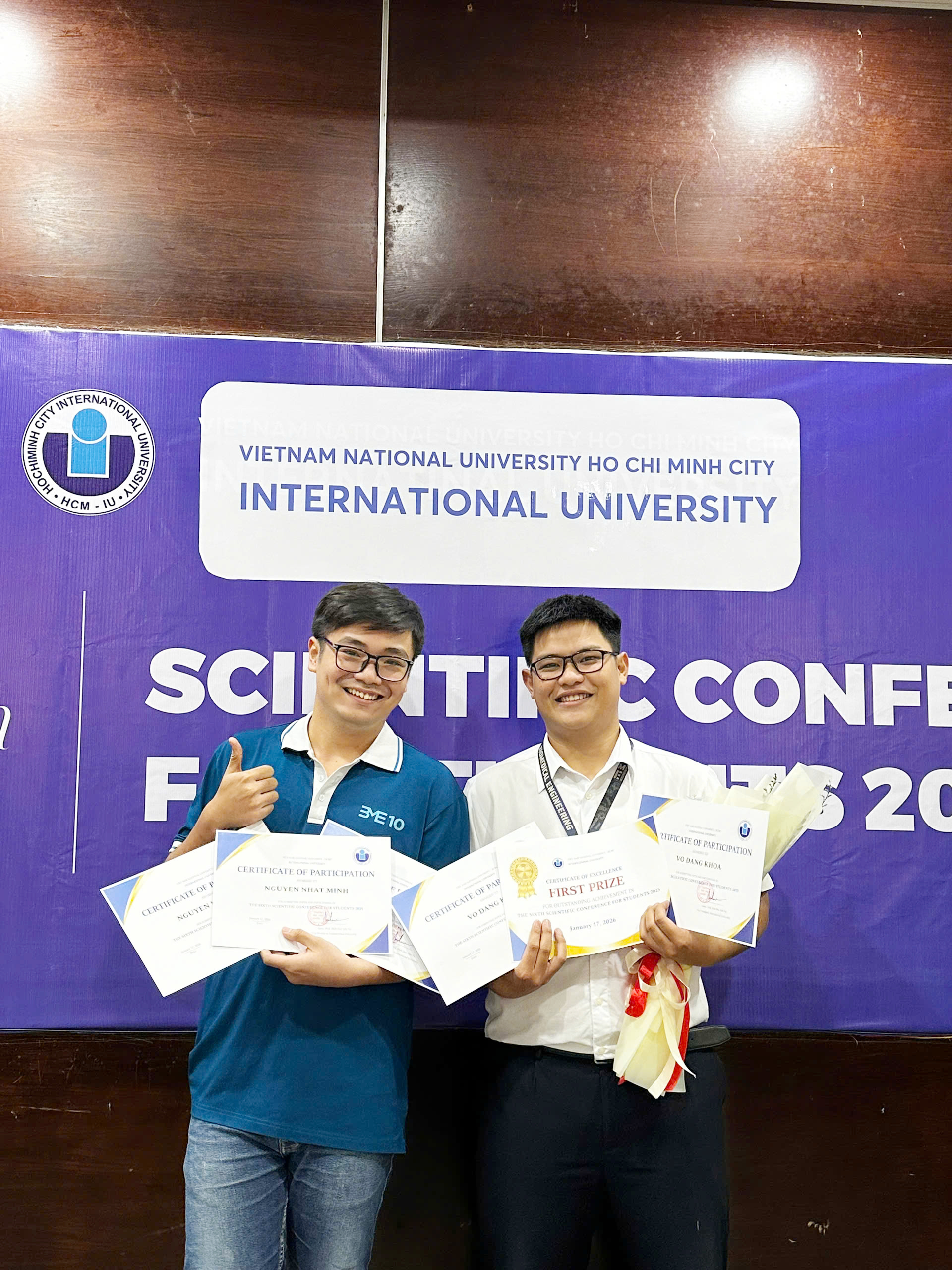
Mr. Võ Đăng Khoa – a fourth-year student of the Faculty of Biomedical Engineering, and Mr. Nguyễn Nhật Minh – a graduate student of the Faculty of Biomedical Engineering, received the First Prize certificates at the 6th Student Scientific Research Conference in 2025.
BTT: How did the team overcome these challenges? Were there any “hard-earned lessons” along the way?
Research Team: To overcome these challenges, the team persistently carried out a systematic troubleshooting process, combining hardware optimization with precise calibration using specialized measurement instruments. The most significant “hard-earned lesson” we learned was the critical importance of temperature control and digital component management. Instead of using fixed resistors, switching to digital potentiometers completely resolved the lack of flexibility in controlling light intensity. A key practical takeaway was the need to consistently cross-check experimental data with standard measurement devices rather than relying solely on theoretical calculations. This approach enabled the team to achieve extremely high experimental linearity, with an R² value exceeding 0.99.
BTT: Could you share the highlight that your team finds most meaningful in this research project—for example, a new discovery, experimental result, model, method, dataset, or demo product?
Research Team: The aspect we feel most proud of is the successful development of a flexible digital light-control system integrating an ESP32-S3 microcontroller, a CAT4104 driver, and an AD5160 digital potentiometer. This solution allows lighting intensity and pulse-width modulation (PWM) modes to be configured entirely via software with exceptionally high accuracy and repeatability, fully replacing manual adjustments that are prone to error. Experimental results demonstrated the superiority of this system, achieving near-perfect linearity with an R² value of up to 0.999, effectively transforming a low-cost research device into a reliable, standardized platform for phototoxicity assessment.
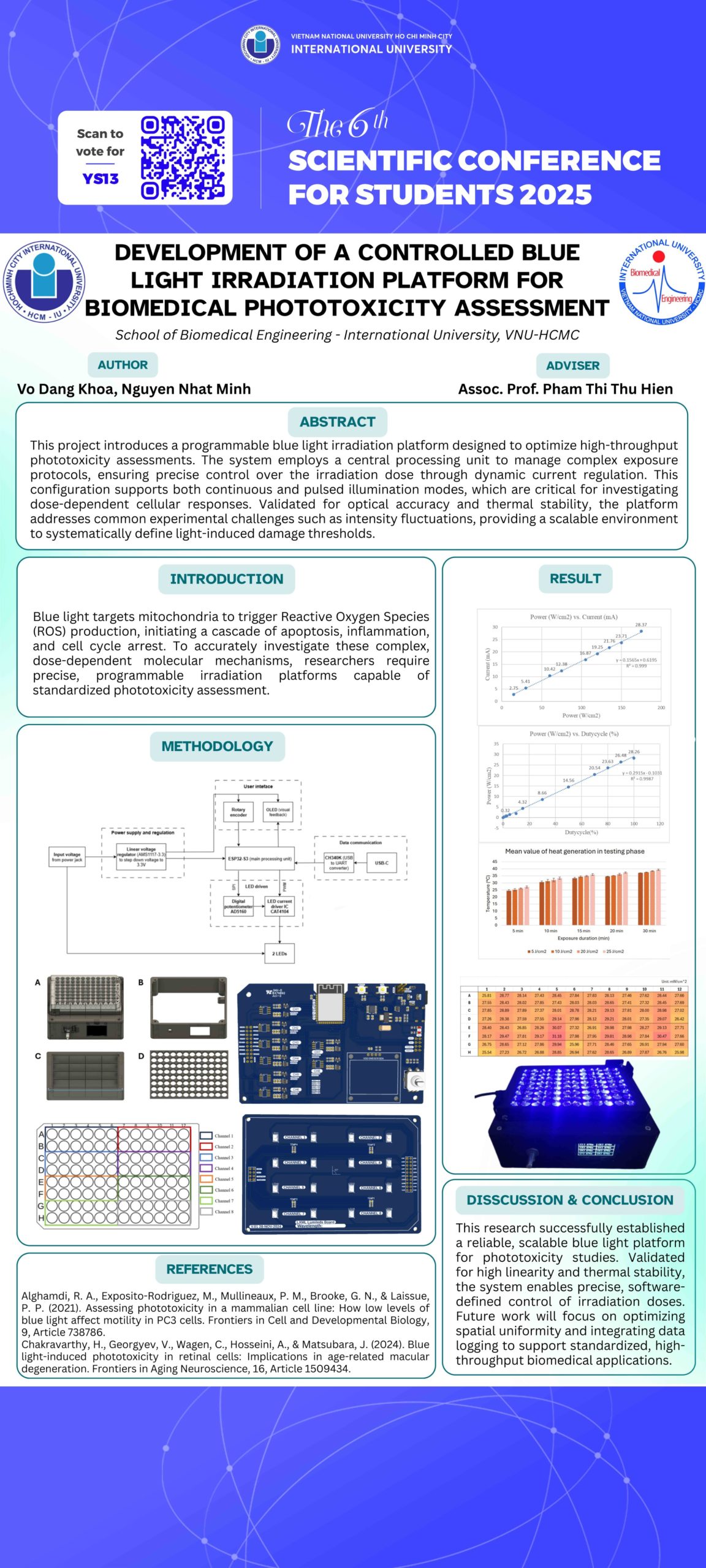
Poster of the research project by Mr. Võ Đăng Khoa – fourth-year student of the Faculty of Biomedical Engineering, and Mr. Nguyễn Nhật Minh – graduate student of the Faculty of Biomedical Engineering.
BTT: How does the team expect this research topic to be applied in practice?
Research Team: We expect this system to become a standardized tool in biomedical laboratories for in-depth studies on the effects of light on cells. Specifically, the project can be applied in the following areas:
- Biomedical Research and Ophthalmology: Used in research institutes to determine safe exposure thresholds of blue light, particularly in studies on retinal damage and macular degeneration.
- Pharmaceuticals and Drug Screening: Applied in photosensitive drug testing processes, enabling rapid assessment of phototoxicity in high-throughput screening workflows using 96-well plates.
- Clinical Treatment: Supporting the development of safer and more effective light-based therapy (phototherapy) protocols in fields such as dermatology or rehabilitation medicine.
Target users: Scientists, healthcare professionals, and students in Biomedical Engineering who require a highly accurate yet cost-effective experimental platform.
With its flexible programmability and stable temperature control, the device is expected to replace improvised lighting setups, thereby enhancing the reliability of domestic research outcomes and helping them meet international standardization requirements.
Keyword: HCMIU, IU, SDG3-Sức khỏe và cuộc sống tốt, SDG4- Giáo dục có chất lượng, SDG9- Công nghiệp sáng tạo và phát triển hạ tầng