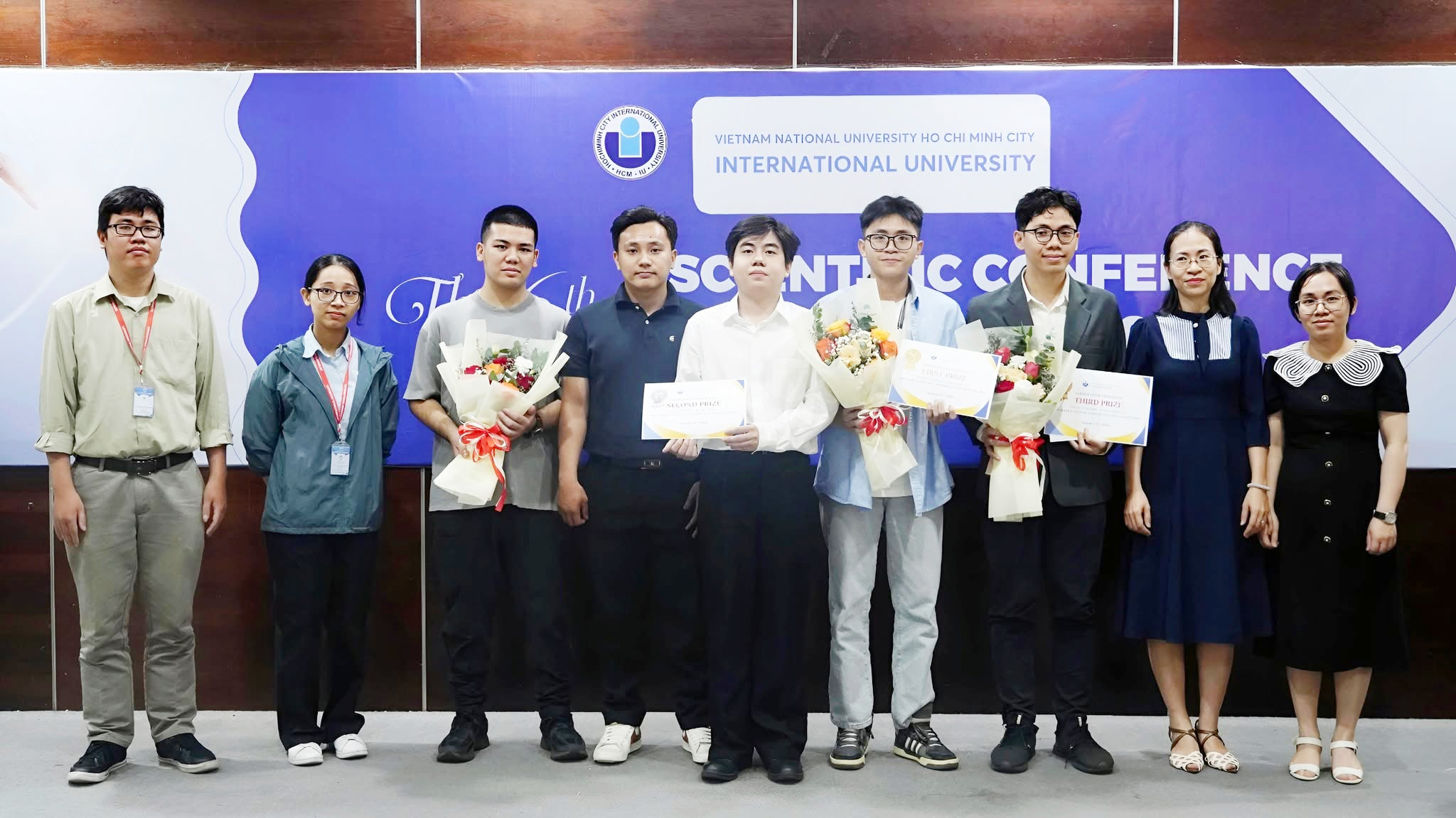
“APPLICATION OF QUANTUM MACHINE LEARNING IN DATA ANALYSIS” FIRST PRIZE – THE 6TH STUDENT SCIENTIFIC RESEARCH CONFERENCE, 2025

A group of students from the Class of 2021 won First Prize at the 6th Student Scientific Research Conference – 2025 with an impressive project titled “Application of Quantum Machine Learning in Data Analysis.” The award-winning team consists of Nguyễn Hồng Phước, Hà Quang Huy, and Võ Cự Khôi, under the supervision of Dr. Nguyễn Quang, lecturer of the Department of Physics at the University of Science, VNU-HCM, and Dr. Vũ Tuấn Hải, lecturer at the University of Information Technology.
When selecting their research topic, the three final-year students majoring in Space Engineering were fortunate to work with lecturers from the Department of Physics—on a topic that was entirely new compared to the knowledge they had previously acquired in class. “Our group was completely captivated by the topic suggested by a lecturer of the department,” shared Nguyễn Hồng Phước, the representative of the research team.
The team’s research focuses on quantum computing and quantum computing frameworks, both of which are widely regarded as the next major leap beyond the limitations of classical computers. However, at present, most quantum computing systems remain relatively small in scale, with a limited number of qubits (or are prohibitively expensive for widespread research use). Simply put, the more complex a problem is, the more qubits—acting as information carriers—are required to store and process data in parallel.
“This makes research and experimentation on real quantum computers extremely costly, so many studies have to rely on simulations. In that context, quantum machine learning—a relatively new research field—has emerged as a promising direction, but it also raises a critical question: how can we identify suitable configurations and models when quantum resources are still limited?” emphasized Hà Quang Huy, a member of the research team.
After weeks of careful consideration, the team decided to adopt the Genetic Algorithm, as all members agreed that it is an optimization method inspired by natural evolution, capable of searching for high-quality solutions in very large spaces without exhaustively testing every possibility. By combining Genetic Algorithms with a quantum learning framework, the team approached the problem in a more practical way: leveraging the potential of quantum machine learning while reducing the cost of pure “trial-and-error” experimentation. The motivation behind the project stemmed precisely from the gap between the theoretical potential of quantum computing and the real-world constraints of its current implementation.
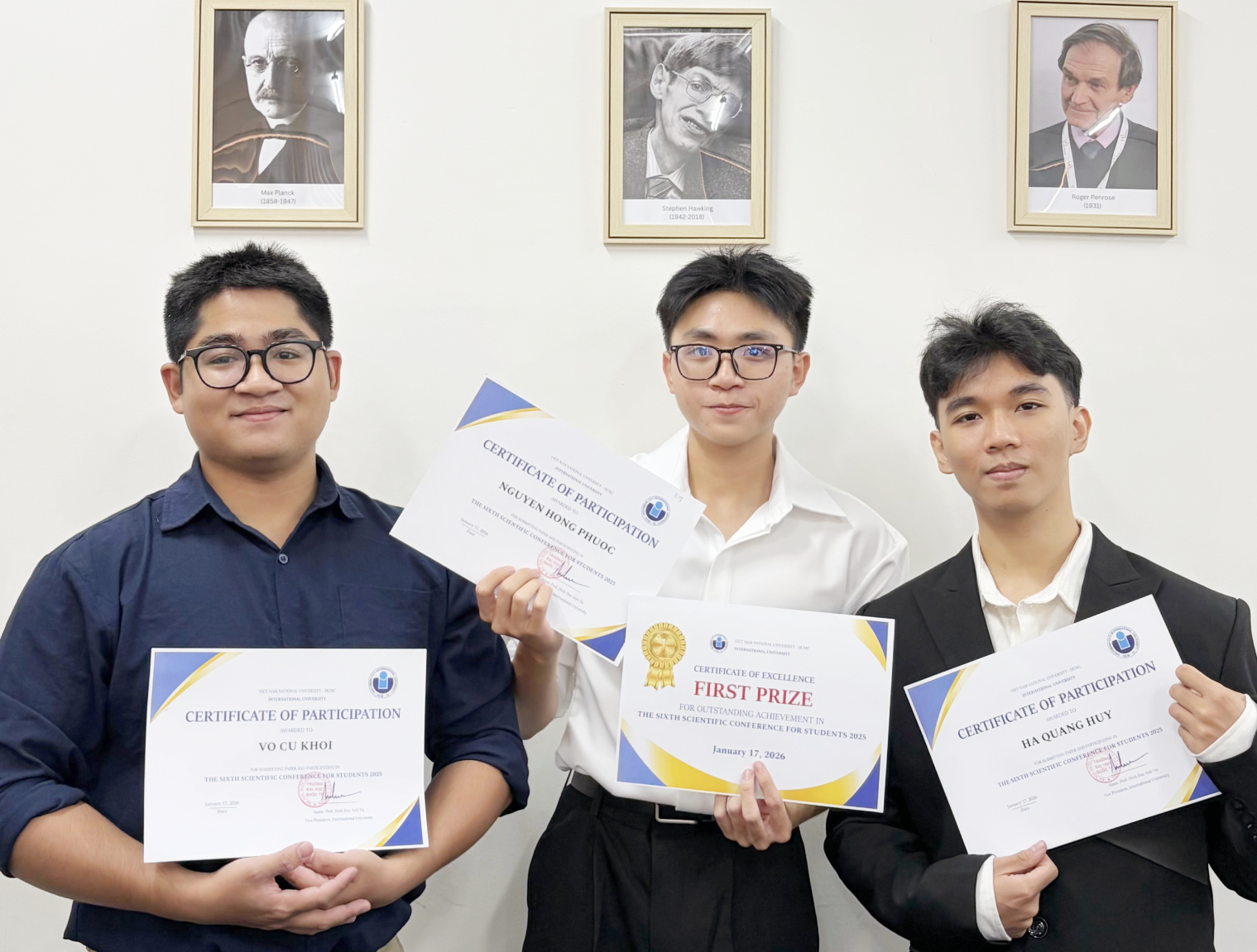
Nguyễn Hồng Phước, Hà Quang Huy, and Võ Cự Khôi—students from the K2021 cohort of the Department of Physics—posed with their certificates recognizing the highest achievement at the 6th International University Student Scientific Research Conference in 2025.
Recalling the difficulties they faced when first starting the project, the group emotionally reflected on the initial stage of entering a completely new research field, which required a significant investment of time to build the necessary foundational knowledge. The complexity of the topic exceeded their initial expectations and repeatedly led the team to consider adjusting or even changing their research direction. At the same time, differences in individual perspectives posed additional challenges, demanding a strong spirit of collaboration and effective coordination.
After encountering these obstacles, the group discussed and analyzed the underlying causes together, eventually realizing that their greatest limitation throughout the project was a lack of proactive communication with their academic supervisors. “Overconfidence and hesitation to share our real difficulties caused us to miss many opportunities for timely guidance, which unnecessarily prolonged our search for solutions,” recalled Võ Cự Khôi, a member of the research team.
After winning First Prize and spending several consecutive months working with dedication, the group gained a deeper appreciation for the value of connection and the importance of timely, enthusiastic support from their lecturers.
“The quality of a research project does not lie solely in students’ knowledge or skills, but also in the wise guidance of those who lead the way. Despite our stumbles and avoidable mistakes, we were incredibly fortunate to have our lecturers constantly by our side—patiently guiding us and opening up directions we had never imagined. Thanks to that, today we can proudly stand here with a truly meaningful achievement,” all three final-year students from the Department of Physics shared in agreement.
Upon completion, the group’s research proposed a method for identifying optimal quantum circuits for different types of datasets without requiring deep insight into the internal workings of the quantum circuits themselves. This approach lays the groundwork for broadening accessibility and accelerating the application of quantum computing across various fields.
“At the current stage, we view this topic as a preparatory step that supports future research in quantum computing in the near term. As quantum hardware gradually stabilizes and larger numbers of qubits become widely usable, the need to optimize models and resources will become extremely important. Our work aims to serve as an automated tool for finding good configurations, helping to reduce experimental costs,” Võ Cự Khôi further shared about the group’s future aspirations.
From a practical application perspective, the group’s research direction can be applied to a wide range of optimization problems or problems with very large sample spaces, especially in fields that require complex data processing. Examples include finance (portfolio optimization), logistics (route optimization and resource allocation), as well as materials science and pharmaceuticals (discovering new structures or formulations). These are all problems characterized by vast solution spaces, where genetic algorithms and quantum computing are expected to demonstrate significant advantages.
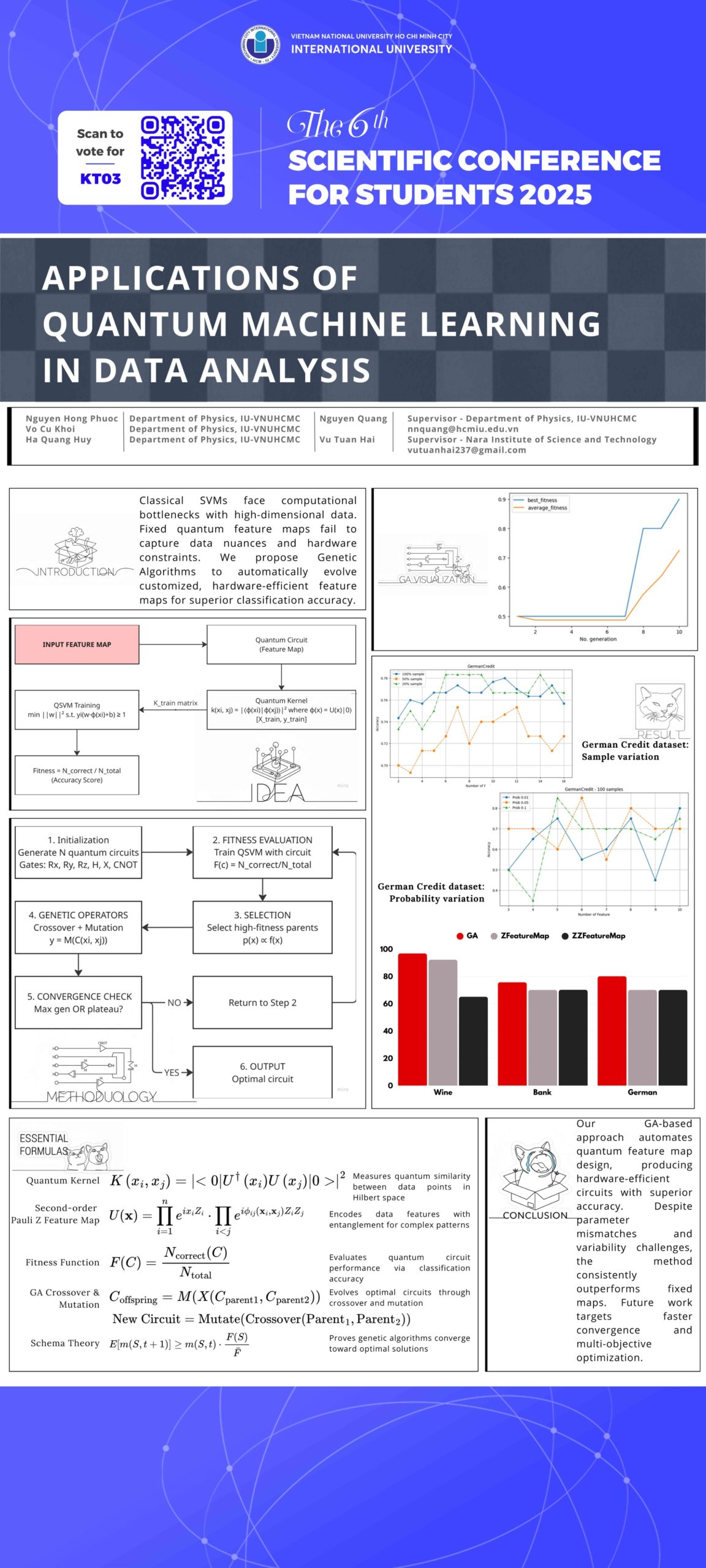
Poster presenting the group’s First Prize–winning research project at the 6th Student Scientific Research Conference, 2025.
Nguyễn Hồng Phước added: “In the short term, the project can be applied in research and simulation environments, supporting scientists in testing quantum machine learning models more effectively. In the long term, we hope it will contribute to bringing quantum machine learning closer to real-world problems faced by businesses and industry.”
|
ADVICE FROM THE GROUP FOR STUDENTS
|
Keyword: HCMIU, IU, SDG4-Quality education , SDG9-Industry innovation and infrastructure